Binance Futures Testnet Trading Bot
Automated trading bot built on Binance Futures Testnet with strategy logic, risk management, and API-driven order execution.
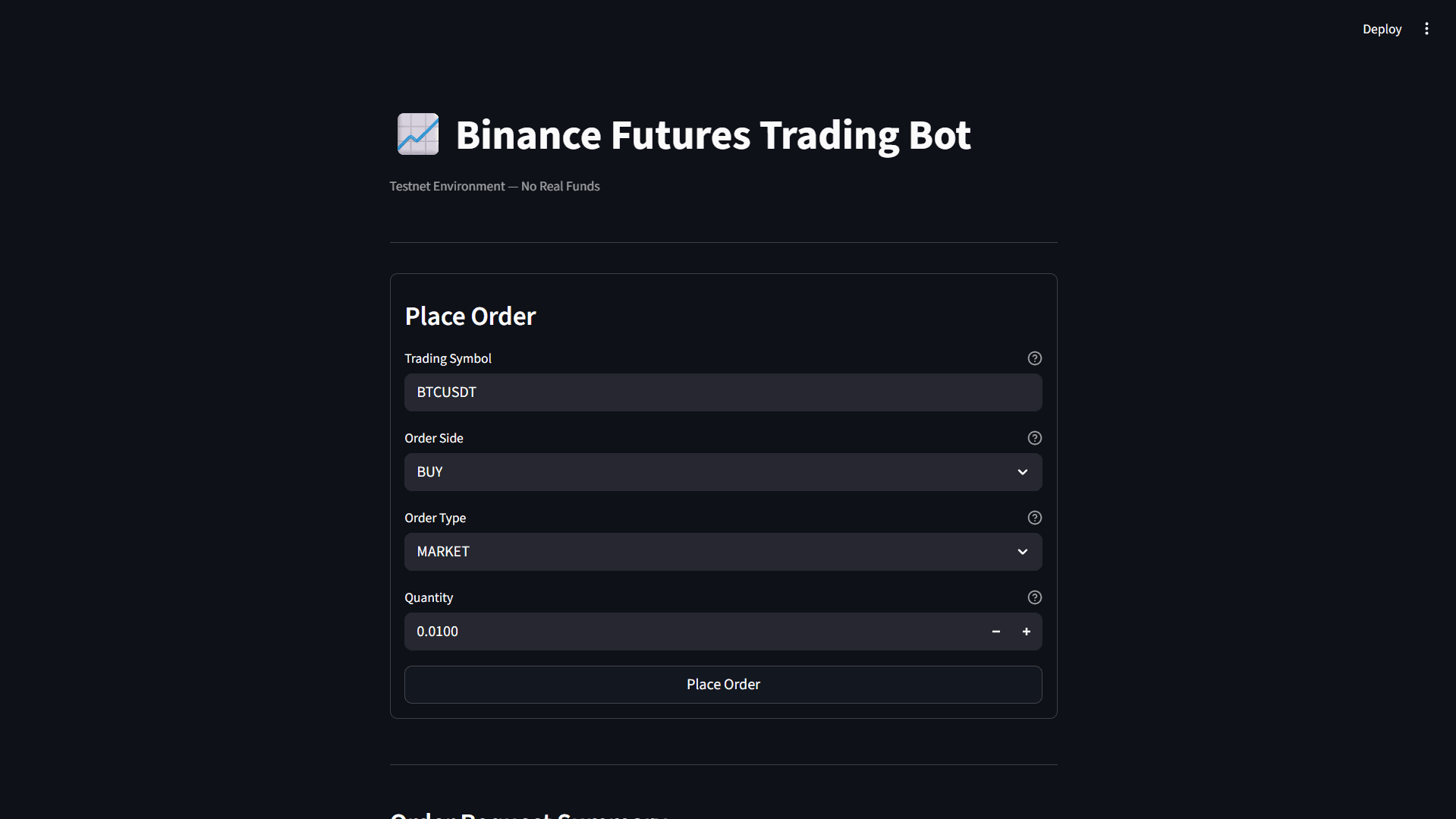
Overview
An automated trading bot developed for Binance Futures Testnet that executes trades based on predefined strategy conditions, integrates risk management mechanisms, and handles real-time market data through Binance APIs. The project focuses on systematic trade execution, API reliability, and controlled testing in a simulated trading environment.
The Problem
Manual trading is time-sensitive and emotionally driven, often leading to inconsistent execution and risk exposure. Building an automated trading system requires reliable API integration, real-time market data handling, order management, and basic risk control mechanisms. The challenge was designing a bot that could systematically execute trades on Binance Futures Testnet while maintaining clean architecture and safe experimentation without real capital exposure.
Architecture
The trading bot follows a modular architecture separating market data ingestion, strategy evaluation, order execution, and risk management. Market data is fetched from Binance Futures API endpoints, processed in real time, and passed into a strategy engine that evaluates entry and exit conditions. The execution layer handles order placement, position monitoring, and response validation. The system runs in a controlled loop, ensuring continuous evaluation of trading signals while maintaining API communication reliability.
Backend Design Decisions
The system is implemented in Python with structured separation between API handling, trading logic, and configuration management. Binance API credentials are securely managed via environment variables. The order execution module includes validation checks for position sizing and leverage parameters. Logging mechanisms track trade entries, exits, and API responses for debugging and evaluation. The design prioritizes clarity and deterministic behavior over high-frequency optimization.
LLM Integration
This project does not rely on LLM integration. Instead, it focuses on rule-based trading strategy implementation and deterministic signal evaluation. Strategy logic is defined programmatically using technical indicators and conditional rules. This decision ensures predictable behavior and easier debugging compared to AI-driven trading logic.
Database Structure
The bot operates primarily as a real-time execution system and does not require a persistent database for core functionality. Trade logs and execution history can be stored locally or extended to a relational database if long-term analytics are required. The system design allows future integration with a database for performance tracking, trade analytics, and strategy comparison.
Technical Tradeoffs
Using Binance Futures Testnet enables safe experimentation but does not perfectly replicate live market latency and liquidity conditions. A rule-based strategy ensures predictability and easier debugging but lacks adaptability compared to machine learning-based approaches. Running the bot in a loop-based architecture simplifies implementation but may not scale for high-frequency or distributed trading strategies. The system prioritizes learning, reliability, and safe testing over production-level trading optimization.
Future Improvements
Future improvements include implementing more advanced risk management techniques such as dynamic stop-loss adjustments, adding performance analytics dashboards, integrating persistent storage for trade history, introducing backtesting capabilities, and supporting multiple strategy modules. The architecture can also be extended to support live trading environments with enhanced monitoring and alerting systems.
Tech Stack
Timeline
February 2025