GitInsights: AI-Powered GitHub Repository Analyzer
AI-driven tool that analyzes GitHub repositories and generates structured reports on project readiness, clarity, and overall quality.
Overview
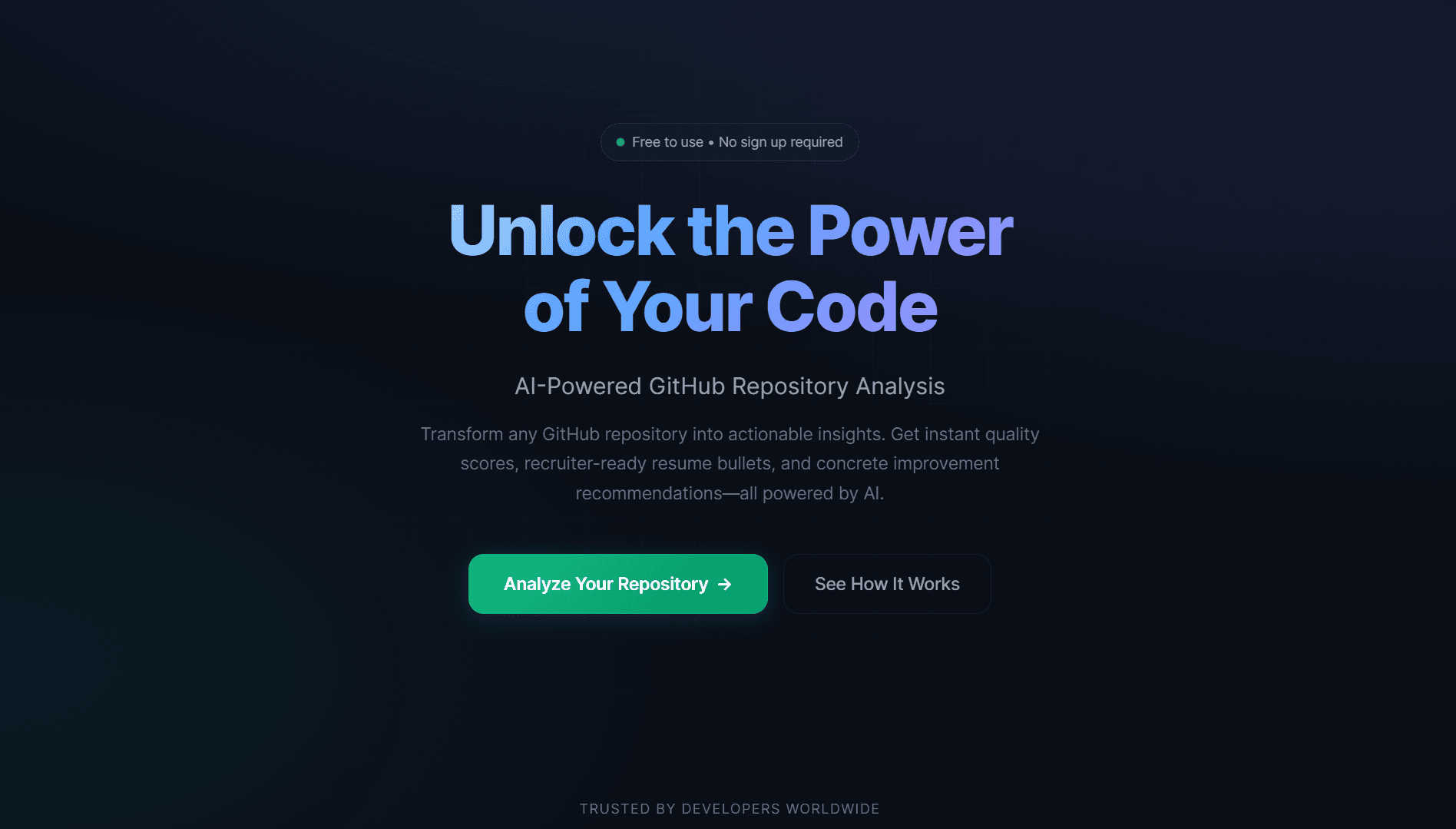
GitInsights is a web-based tool that evaluates GitHub repositories and generates structured feedback reports to help developers understand how their projects appear to recruiters and collaborators. It analyzes repository structure, documentation quality, clarity, and overall presentation using AI-assisted evaluation.
The Problem
Many developers build solid projects but struggle to understand how their repositories are perceived externally. Recruiters often evaluate codebases quickly, focusing on documentation clarity, structure, and professionalism. There is no simple way for developers to objectively assess whether their repository feels “ready” to share. The challenge was building a system that can programmatically analyze repository metadata and content, then generate meaningful, structured feedback using AI.
Architecture
GitInsights follows a client-server architecture. The frontend provides a simple interface where users submit a GitHub repository URL. The backend fetches repository metadata using the GitHub API, processes key elements such as README content, folder structure, and commit patterns, and constructs structured inputs for AI-based evaluation. The AI layer then generates a detailed report assessing clarity, structure, and perceived readiness. The system separates repository analysis logic from report generation logic to maintain modularity.
Backend Design Decisions
The backend is built using FastAPI with asynchronous request handling to manage GitHub API calls efficiently. Repository data fetching is isolated within a dedicated service layer to prevent tight coupling with evaluation logic. Structured preprocessing ensures that only relevant repository information is passed to the LLM, reducing token usage and improving response quality. Error handling is implemented for invalid repositories, rate limits, and incomplete data scenarios. The design prioritizes clean API boundaries and maintainability.
LLM Integration
GitInsights integrates an LLM to generate structured evaluation reports based on processed repository data. Instead of raw prompting, the system constructs organized inputs including README summaries, repository structure indicators, and metadata signals. The prompt enforces consistent report formatting, including strengths, weaknesses, and improvement suggestions. The LLM layer is designed to remain flexible, allowing experimentation with different models without major architectural changes.
Database Structure
GitInsights operates primarily as a stateless analysis tool. Temporary repository data is processed in-memory during evaluation, while optional report history can be stored for user sessions if enabled. If persistence is required, a relational database structure can store repository URLs, generated reports, timestamps, and user associations. The schema is kept lightweight to maintain system simplicity.
Technical Tradeoffs
Using AI for repository evaluation improves qualitative assessment but introduces response latency and variability. GitHub API reliance ensures reliable metadata access but is subject to rate limits. Structured preprocessing reduces token usage and improves consistency, though it requires additional logic before AI invocation. The system prioritizes clarity and actionable feedback over deep static code analysis, trading exhaustive inspection for faster, high-level evaluation.
Future Improvements
Future improvements include adding deeper static code analysis, incorporating metrics such as test coverage or commit consistency scoring, implementing report comparison over time, introducing recruiter-mode summaries, and adding caching mechanisms for repeated repository evaluations. Multi-model fallback logic could improve reliability and performance.
Tech Stack
Timeline
January 2026 - February 2026